

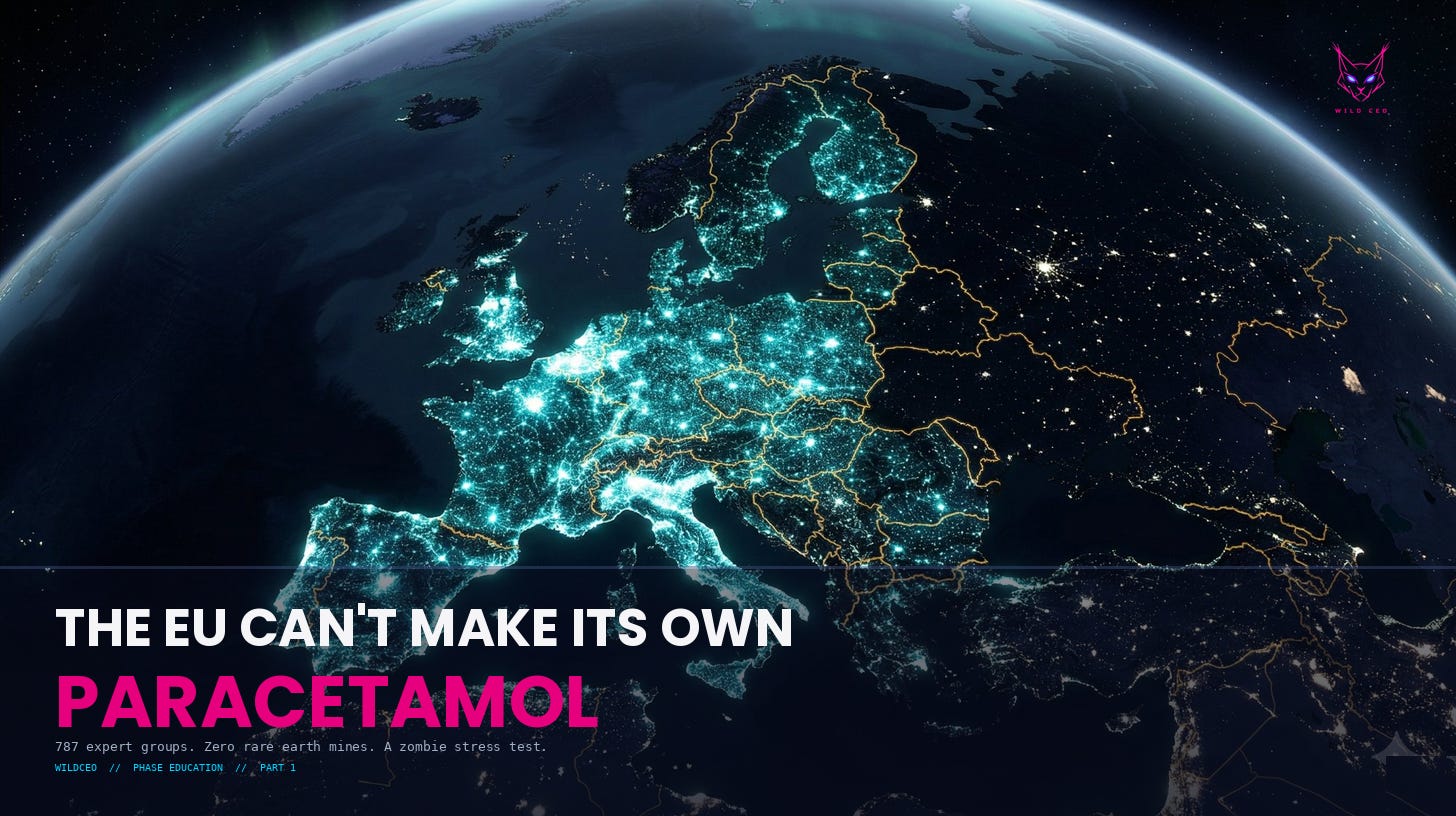
The European Union knows it can’t make its own paracetamol. That’s not the embarrassing part. The embarrassing part is what it did about it.
Somewhere in a filing cabinet in Brussels — or more likely on a SharePoint drive that twelve people have access to — there is a document. It lists 276 medicines that the European Union has officially classified as “critical.” Paracetamol is on the list. So are most common antibiotics, the blood thinner heparin, half the chemotherapy drugs in use today, and vitamin B1. The document exists because someone at the European Commission finally asked a question that should have been asked twenty years earlier: where do the ingredients in our medicines actually come from?
The answer was uncomfortable. Between 60 and 80 percent of the active pharmaceutical ingredients consumed in the European Union come from two countries: China and India. For paracetamol specifically — the most widely consumed medicine on the continent, the pill you reach for when your child has a fever at 2 AM — the dependency is total. The last European factory that produced it closed in France in 2008. Nobody issued a press release. Nobody in Brussels convened a working group. Nobody asked what would happen if the supply stopped.
Eighteen years later, the EU’s response has finally arrived. It’s called the Critical Medicines Act. It was proposed in March 2025. It contains no mandate for domestic API production — only incentives. It was published without an impact assessment. Its budget is €88.5 million, which is roughly the cost of two kilometres of German autobahn, or about what a mid-sized pharmaceutical company spends on a single clinical trial. Belgium’s health minister called the final text “weaker rather than stronger.” Malta called it “a very disappointing failure to deliver to our patients.” As of April 2026, it is still in negotiations.
Meanwhile, the only actual reshoring project anyone can point to — a Seqens paracetamol plant in Roussillon, France — was announced with great fanfare in June 2020. Six years later, it is still not operational. It covers exactly one molecule.
This is not a story about paracetamol. Paracetamol is the symptom. This is a story about how the world’s richest economic bloc — an $18 trillion economy, 450 million citizens, home to some of the finest universities and engineers on Earth — systematically dismantled its ability to produce the things that keep it alive, and then, when it finally noticed, responded with committees instead of factories, targets instead of tools, and legislation that incentivises rather than builds.
What this article is — and what it isn’t
At Phase Education, we teach a different way of understanding the world. Not through a single subject — not just economics, not just history, not just chemistry — but through five integrated lenses we call PHASE: Philosophy, History, Arts, Science, and Environment. The idea is deceptively simple: no real-world problem lives inside a single discipline. Energy policy is physics and geopolitics and history and moral philosophy — all at once. Separate them, and you get a policy paper. Combine them, and you see what’s actually there.
This article is PHASE thinking in action. And it uses a thought experiment that sounds absurd but turns out to be the most efficient X-ray of EU strategic policy ever devised:
A zombie pandemic hits every country on Earth except the European Union.
A wall goes up at the EU’s 27 external borders. No trade. No imports. No exports. No Norway — it’s not in the EU, and as we’ll see, this matters enormously. No China, no America, no anyone. Just 450 million people, whatever is inside the wall, and however long the reserves last.
The zombies are fiction. Every single number in this article is fact.
But here’s the crucial thing: we’re not asking the obvious question — “can the EU survive?” Of course it can, diminished but alive. The EU grows 130% of the wheat it needs, has nuclear power, wind farms, SWIFT, and ASML. The real question is far more uncomfortable:
Given what the EU knows about its own vulnerabilities — which it has publicly documented in exhaustive detail — how good is its thinking about fixing them?
The answer, documented across nine sectors with data from 2024–2026, is: not just inadequate, but in several cases actively self-defeating. The EU has created regulations that increase the very dependencies they were designed to reduce. It has announced €800 billion in defence spending that is 81% fictional. It has set a 20% semiconductor target that its own auditors call “unrealistic.” And it has spent €964 billion responding to an energy crisis — with a 25:1 ratio of consumer subsidies to actual infrastructure investment.
This is Part 1 of a five-part series. Here, we diagnose the patient. In the parts that follow, we build the cure.
The €4 trillion axiom
Every civilisation, whether it knows it or not, runs on an axiom — an organising belief so deeply held that it shapes every institution, every budget line, every instinctive response to crisis. Understanding the axiom is the first step in understanding why a civilisation does what it does.
America’s axiom: the individual who builds something extraordinary deserves to keep the rewards. The builder is the hero of the American story. This is why America has SpaceX — a private company that builds rockets — and why TSMC Arizona went from empty desert to producing cutting-edge 4nm semiconductors in three years. When a civilisation celebrates builders, it gets building.
China’s axiom: civilisational continuity requires state architecture. The state plans, the state builds, the state controls the timeline. This is why China has 50,000 km of high-speed rail constructed from nothing in 17 years, at construction costs of $17–21 million per kilometre versus Europe’s $25–39 million. When a civilisation centralises building authority, it gets speed.
The EU’s axiom: nobody should have to struggle.
It sounds beautiful. It may be the most expensive sentence in the history of economic policy.
EU member states spend 27–30% of GDP on social protection — pensions, healthcare, unemployment benefits, housing subsidies, disability payments. France spends 32%. Denmark spends 28%. The combined social spending across all 27 member states exceeds €4 trillion per year. That is more than the entire GDP of Germany.
To be clear: this is not an argument against sick people getting healthcare or retirees receiving pensions. They should. This is a structural observation about what happens when protection — not production, not innovation, not building — becomes a civilisation’s organising principle. It changes the psychology of 450 million people. It teaches them that the system will always provide. That energy will flow. That medicine will appear on the pharmacy shelf. That someone, somewhere, is handling the supply chain. You don’t need to understand it. You don’t need to build it. You just need to vote for the people who promise to keep it running.
The proof of what this axiom produces under pressure arrived in 2022, when Russia weaponised natural gas. Prices spiked 1,000%. Seventy percent of EU ammonia production shut down overnight. And the EU’s response — documented meticulously by Bruegel — revealed the axiom at work with the force of seventy years of institutional muscle memory.
Total energy crisis spending: €964 billion over three years.
Of that, 62% went to consumer subsidies — price caps, rebates, cheques mailed to households. Infrastructure development — the actual building of new energy capacity — received €8.8 billion.
That is a ratio of 25 to 1. Twenty-five euros spent protecting citizens from the consequences of dependency for every one euro spent eliminating the dependency itself.
The axiom doesn’t just allocate budgets. It allocates attention. The political incentive structure in a welfare civilisation rewards politicians who distribute, not politicians who build. Building takes a decade and benefits the next government. Subsidies arrive before the election. In the EU’s system, the rational political choice is always the same: protect citizens from the symptom, never cure the disease.
The comfortable path: seventy years of choosing imports over independence
The EU didn’t stumble into dependency by accident. At every fork in the road — and there have been many — it chose the comfortable path. The pattern is so consistent it looks less like a series of decisions and more like a gravitational pull.
1951 — The European Coal and Steel Community. Six nations pool the raw materials of war under shared governance. The logic is elegant: make war materially impossible by sharing the inputs to warfare. This works. And it is the last time the European project will build something first and regulate it second.
1973 — The OPEC oil embargo proves that imported energy can be weaponised. Europe’s response? Not to develop domestic energy independence. Not to fast-track nuclear (France, to its credit, does exactly this, which is why it has 56 reactors today). Instead: diversify suppliers. Find new countries to buy from. The pattern is established and will repeat for fifty years: when a dependency is exposed, the EU diversifies it instead of eliminating it.
The 1990s — Post–Cold War euphoria. The world is flat. Trade is peace. Pharmaceutical companies shift API production to China and India — 40% cheaper. Semiconductor manufacturing migrates to Taiwan and South Korea. Europe’s share of global chip production begins its long, quiet slide from 44% to 9%. Each factory closure is reported as “restructuring” or “efficiency optimisation.” Nobody counts what’s being lost because nobody thinks supply chains are a strategic issue. That’s a problem for other centuries.
2008 — The last EU paracetamol factory closes in France. Three years later, Germany commits to closing all its nuclear power plants after Fukushima — a tsunami in Japan triggers the decommissioning of perfectly functional reactors 9,000 km away. The EU is now simultaneously abandoning domestic energy production and domestic pharmaceutical production, in the same decade, and nobody in Brussels connects the dots.
2022 — Russia invades Ukraine and weaponises gas. The EU discovers it has been paying Russia roughly €400 million per day for energy imports. Prices spike. Ammonia plants close. The response: over €700 billion in energy subsidies to consumers. Not new energy infrastructure. Not emergency reactor construction. Not mine permits for domestic resources. Subsidies. The welfare axiom kicks in with the accumulated force of seventy years: protect citizens from the consequences of the dependency. Do not, under any circumstances, ask them to build.
2023–2025 — Three emergency acts: the Chips Act, the Critical Raw Materials Act, the Critical Medicines Act. Three pieces of legislation that collectively acknowledge — in writing, in legislative text — that the European Union cannot produce the medicines, chips, and minerals it needs to survive. Three frameworks with ambitious targets for 2030. And as of April 2026: zero factories built. Zero mines opened. Zero API plants operational. The identify-announce-create-a-board-wait cycle completes itself once more.
The scorecard: what breaks, when, and what Brussels did about it
Now we seal the wall. Every border shuts. The zombie pandemic is here. What does the EU actually have — and what is it missing?
Five sectors in red. In every single one, the institutional response follows the same template: an act that incentivises but does not mandate, targets set for 2030, an advisory board created, and a budget that is a rounding error compared to the scale of the problem. Let’s walk through the worst ones — not just the numbers, but what the EU did when it saw the numbers.
The medicine cabinet: four to eight weeks, then silence
Here is a number that should keep every EU health minister awake at night: 60–80% of Active Pharmaceutical Ingredients consumed in Europe come from China and India. Not the finished pills — the actual chemical compounds that make medicine work. The APIs. Without them, a paracetamol tablet is a lump of chalk.
Antibiotics: 70–80% sourced from China. Heparin, the blood thinner used in every surgical ward: 80%+ from China. Vitamin B1: 95%. Most EU countries maintain medicine stockpiles measured in weeks, not months. Germany is a rare exception with a six-month antibiotic reserve; most countries have far less.
Behind the zombie wall, the timeline is brutal. Paracetamol runs out in 4–8 weeks. Common antibiotics face shortages within 2–3 months. Chemotherapy agents follow. And the EU cannot compel a single company to produce anything — it has no equivalent to the US Defence Production Act. The Critical Medicines Act offers incentives, not mandates. Its budget — €88.5 million — wouldn’t cover the cost of a single modern API production line.
What makes this worse is the direction of travel. EuroAPI, the Sanofi spinoff created specifically to be Europe’s champion API producer, is closing factories — shuttering Brindisi in Italy, divesting 13 APIs, cutting 550 jobs. The dependency isn’t stabilising. It’s deepening. And Chinese APIs are 40% cheaper than anything Europe can produce, because China subsidises energy, land, and environmental compliance in ways that the EU’s regulatory architecture makes structurally impossible to match.
The Seqens paracetamol plant — announced June 2020, still not operational April 2026, covering one molecule — is not an outlier. It is the system working at its actual speed.
The chip paradox: owning the tool, having no factory
There is a company in Veldhoven, the Netherlands, called ASML. It makes a machine called an EUV lithography system. It costs between €200 and €380 million. It weighs 180 tonnes. It contains over 100,000 components sourced from hundreds of suppliers. And it is the only machine on Earth that can manufacture semiconductors below 7 nanometres.
ASML has a 100% global monopoly. Every advanced chip made by TSMC, Samsung, or Intel is fabricated on an ASML machine. Without ASML, modern computing, artificial intelligence, and autonomous vehicles do not exist.
The EU makes the tool that enables modern civilisation. And yet the EU produces only 9% of the world’s chips — down from 44% in 1990.
For advanced chips below 7nm, the EU’s production share is effectively zero. All cutting-edge chips come from Taiwan and South Korea — both behind the zombie wall. The EU Chips Act set a target of 20% global production by 2030. The EU’s own forecast: 11.7%. The European Court of Auditors called the target “unrealistic.” All 27 member states formally agreed, through the Semicon Coalition, that it is “too broad, lacking clear strategic direction.”
The flagship projects are dead. Intel Magdeburg — a €30 billion fab backed by €9.9 billion in German subsidies — was permanently cancelled in July 2025. STMicro/GlobalFoundries Crolles — a €7.5 billion joint venture — was shelved, with both companies expanding in China instead. The only fab under construction is TSMC Dresden, producing 16/12nm chips — three generations behind the cutting edge — by 2027 at earliest.
The contrast with the United States is not subtle. TSMC Arizona is already producing 4nm chips with a 92% yield rate — surpassing TSMC’s own Taiwan fabs. The US has over 140 semiconductor projects across 30 states representing $640 billion in investment. The EU has one fab, three generations behind, and a cancelled dream.
800 deposits, zero mines, 787 expert groups
The EU sources 98% of its rare earth magnets from China. Every EV motor, every wind turbine generator, every guided missile system depends on neodymium and dysprosium magnets that come, overwhelmingly, from a single country. China controls 91% of global rare earth refining and 94% of permanent magnet manufacturing. The EU’s recycling rate for rare earths: below 1%.
But here’s the detail that transforms this from a problem into an indictment: the EU has over 800 known critical raw material deposits across 33 European countries. The GSEU project — funded by the European Commission itself — mapped them all. Published the data. Made it available. The resources are right there, under European soil, catalogued and quantified.
So why zero mines? Because 85% of those deposits sit under or within 5 km of environmentally protected land. The EU’s own environmental regulations — Natura 2000 sites, habitat directives, water framework directives — make it effectively illegal to mine its own strategic resources. The Critical Raw Materials Act set a 27-month permitting target for new mines. The real-world global average: 15.7 years from discovery to first production. In Europe, it will be longer.
LKAB — Europe’s largest rare earth deposit, discovered in Kiruna, Sweden, announced with enormous political fanfare in January 2023 — won’t produce refined rare earth oxides at any meaningful volume until the 2030s. Serbia’s Jadar lithium mine was designated a CRMA strategic project in June 2025 and mothballed five months later. Portugal’s Barroso lithium has been in environmental permitting since 2020, pushed to 2028.
The RESourceEU action plan, adopted December 2025, mobilises €3 billion — from existing budget lines, not new money. Paul Voss, Director-General of European Aluminium, offered the verdict that no official document will: “There’s not really any money there.”
The EU has 800 mineral deposits mapped. Zero mines operating. 787 expert groups advising. The resources are under their feet — and under their own regulations.
€800 billion for defence — and why 81% of it is imaginary
In March 2025, the EU announced “ReArm Europe“ with a headline number designed to impress: €800 billion. The breakdown tells a different story. Approximately €650 billion is permission for member states to borrow more without triggering EU fiscal deficit rules. This is not money. It is an administrative relaxation of borrowing limits — the equivalent of a bank raising your credit card limit and counting that as income. Another roughly €150 billion came in the form of EU-level loans through the SAFE instrument — which 8 countries, including Germany, didn’t even apply for. Actual direct EU-budget defence spending: approximately €15 billion. Brussels Signal calculated the real new money at roughly €143 billion, describing the rest as “merely a suggestion.”
On ammunition — the most basic metric of military readiness — the EU promised Ukraine one million 155mm artillery shells by March 2024. Delivered: approximately 500,000. Half the target, half late. The subsequent target of 2 million rounds per year? Investigative reporting by Follow the Money found actual European production capacity is “just a third of the targeted number.” Russia: 3–4.5 million rounds per year.
The EU operates over 170 different weapon system types across 27 armies, compared to 30 in the United States. The fragmentation costs an estimated €25 billion every year.
Energy: a trillion euros to change the supplier, not the dependency
The EU imports 57% of all energy it consumes. After spending roughly a trillion euros responding to the 2022 energy crisis, the dependency rate is: 57%. Exactly where it started. What changed was the supplier, not the structure.
Norway is not in the EU. Behind the zombie wall, Norway is gone. And Norway supplies 30% of all EU natural gas and 14% of petroleum. Losing Norway is worse than losing Russia was in 2022, because there’s nowhere left to pivot.
The good news: 71% of EU electricity is domestic — nuclear, wind, solar, hydro, coal. The lights dim but don’t go out. But transportation collapses: oil dependency stands at 94.9% imported. New nuclear? France’s EPR2: first power not until 2038, costs ballooned to €72.8 billion. Wind: 12.9 GW/year installed versus 30 GW needed.
The fertiliser trap: where the EU’s own rules make it worse
The EU’s Carbon Border Adjustment Mechanism (CBAM) was supposed to protect EU industry from cheap, dirty imports. For fertiliser, it does the exact opposite. CBAM taxes imports on carbon content but doesn’t compensate EU producers whose energy costs are 3–4x higher. Result: SKW Piesteritz, Germany’s largest urea producer, closed an ammonia plant in January 2025. EU imports of Russian nitrogen fertiliser: €1.3 billion in H1 2025. Twelve countries asked for exemption.
The self-defeating loop: EU climate rules raise energy costs → EU fertiliser plants close → Russian imports rise → more dependency → more regulation → repeat.
The same tension runs through every sector. You cannot simultaneously ban mining under protected land and complain about rare earth dependency. You cannot phase out nuclear and wonder why you depend on Russian gas. You cannot impose the world’s most expensive carbon pricing and be surprised when factories leave. These aren’t contradictions that coordination can fix. They are the structural consequences of trying to optimise for everything — and achieving paralysis.
What the EU still has — and why it isn’t finished
The EU is not terminally ill. Because alongside those dependencies, it holds assets that require no imports:
SWIFT — headquartered in Belgium. The euro: world’s second reserve currency. Financial infrastructure works perfectly behind the wall.
Nuclear deterrent. France: 290 warheads, submarine-launched. Fully independent. Zero American permission required.
Galileo. 26 satellites. Sovereign navigation.
The single market. 60–65% of EU trade already flows internally. The engine is running.
ASML. 100% global monopoly on the tools of civilisation. Inside the wall.
Knowledge. 450 million citizens. World-class universities. Engineers who can rebuild everything — if given permits, infrastructure, and a political mandate.
The EU doesn’t lack resources, knowledge, or brains. It lacks the political culture to build things — because for seventy years, building has been someone else’s job.
The diagnosis: it’s not the disease — it’s the doctor
The zombie wall doesn’t expose the EU’s dependencies — everyone already knows about them. It exposes the gap between the speed at which the EU identifies problems and the speed at which it solves them.
Medicine stockpiles: weeks. API plants: 5 years. Mines: 15.7 years. Nuclear: 12–15 years. And the EU’s architecture — 27 regulatory regimes, environmental reviews, public consultations, NIMBY opposition, consensus-building across sovereign governments — adds years to every timeline.
The Draghi Report: “existential challenge,” €800 billion/year needed. The EU’s response: Bruegel called it “Draghi on a shoestring.”
The pattern in every sector: announce targets → pass legislation that incentivises, not mandates → create advisory bodies → discover permitting takes a decade → watch flagship projects collapse (Northvolt, Intel, STMicro, Jadar) → quietly revise timelines → stockpiles run out.
The zombie wall doesn’t kill Fortress Europe. The EU’s own speed kills it.
The patient is alive but in critical condition — not because the disease is incurable, but because the doctor keeps prescribing paperwork instead of surgery. In Part 2, we start building the cure
Can a welfare civilisation learn to build like its survival depends on it?
Because it does.
Q.E.D.
Mark Abraham — CEO, Shape Robotics A/S · Creator, Phase Education · Born in Romania
#FortressEurope · #PhaseEducation · #WildCEO · #BuildFirstExplainNever