


On 16 May 2026, Børsen ran a piece titled “Robotselskab bogførte usikre millioner – uden et ord til investorerne”
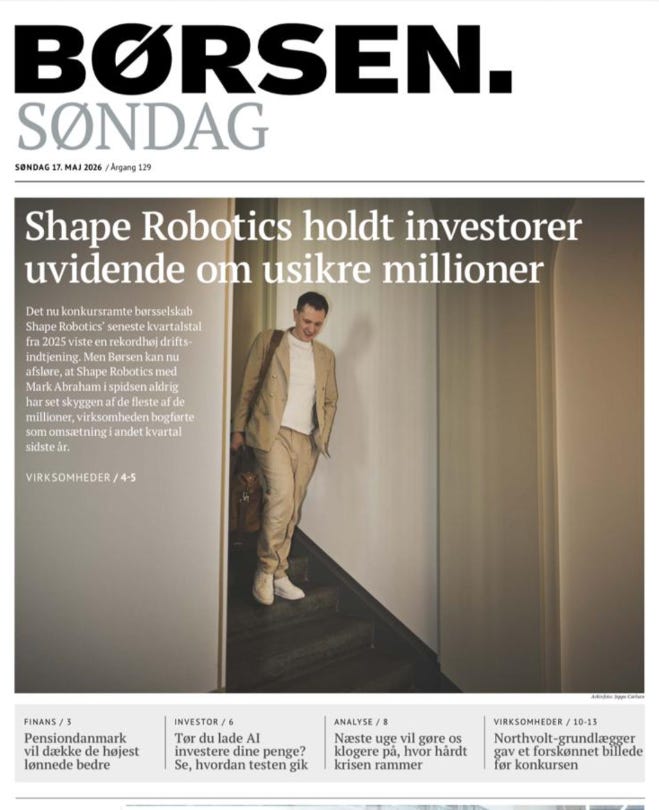

Translation:
— “Robot company booked uncertain millions, without a word to investors.” The piece, amplified the next day on LinkedIn by Lars Kiertzner (statsautoriseret revisor, PhD, the headline expert Børsen quoted), calls our Q2 2025 recognition of DKK 41.9 million “fresh” — Danish accounting slang for reckless.
I’d like to keep this short. Here is what Børsen and Kiertzner forgot to mention, or chose not to.
The court has already ruled. In our favour.
Romanian court file 200000000445775. Public. Verifiable. Open it yourself:
👉 portal.just.ro/2/SitePages/Dosar.aspx?id_dosar=200000000445775&id_inst=2
Shape Robotics Romania SRL won. The Romanian court found that the September 2024 rejection of our PNRR application Shaping Techducators was unlawful. The win is not “alleged.” It is on the record. Børsen mentions this in passing. Kiertzner waves it away with the word “allegedly being appealed.”
Allegedly by whom? On what timeline? With what suspensive effect? The post does not say. Because saying it would collapse the argument.
Where the recognition actually lives
Here is the part the “outside accounting user” missed. The DKK 41.9 million was not booked in Denmark on a hunch. It was recognised in Shape Robotics Romania SRL — in Romania, under Romanian accounting law — based on a formal administrative act of the Romanian Ministry of Investments and European Projects (MIPE).
Translation:
That act is not folklore. It is Raport de verificare nr. 90449/05.12.2024, signed by Director General Laurențiu Alin Crîmu, head of DGMMRR (the directorate that manages PNRR controls and recoveries). The report:
Examines the rejection of the Shaping Techducators application.
Finds the evaluation process flawed (”vicierea procesului de evaluare”).
Confirms that the eligibility grid did not clearly define accreditation as a separate criterion (Ghid solicitant pct. 5.8) — the very reason for the rejection.
Orders a re-evaluation of applications rejected exclusively on that ground.
Recommends an urgent rewrite of the calls in progress to prevent similar situations.
That is not a “compensation claim.” That is the management authority of Romania’s recovery and resilience mechanism formally requalifying the file. The Romanian subsidiary recognised revenue on the basis of that act, audited under Romanian rules. Then — and only then — the result rolled up the consolidation chain to the Danish parent.
Denmark’s job is IFRS 10. That’s it.
Shape Robotics A/S is the Danish parent. Under IFRS 10 — Consolidated Financial Statements — its job is to consolidate the audited figures of its controlled subsidiary, Shape Robotics Romania SRL, line by line, after intra‑group eliminations.
The question of whether the underlying revenue was correctly recognised is answered in Romania, on Romanian books, against the Romanian administrative act and Romanian court file. Not in a LinkedIn post written from the outside by someone who never saw either document.
If the recognition is sound in Romania — and it is, twice over: administratively by MIPE on 5 December 2024, and judicially by the Romanian court in January 2026 — then the consolidated Danish figure is, by IFRS 10, sound.
This is plumbing, not philosophy.
On “very likely to birds on the roof”
Kiertzner asks the audience to imagine an outcome range from “very likely” to “fugle på taget” (birds on the roof — Danish for “pie in the sky”). It is a nice rhetorical figure. It is also the wrong test.
The recognition was not an IAS 37 contingent asset waiting on a courtroom miracle. It was revenue tied to:
A formal MIPE verification report (5 December 2024) flagging the rejection as unlawful and ordering re-evaluation.
A delivered scope of services and teacher training, with documentation.
Auditor Beierholm signing the H1 2025 report without reservation.
That clears IFRS 15 (”probable” — more likely than not) and IAS 20 (”reasonable assurance”). It does not need to clear “virtually certain,” because it is not a contingent asset. It is a revenue line backed by an administrative act and delivered performance.
The January 2026 court ruling did not create the recognition. It confirmed it.
On the comma “allegedly appealed”
A Danish PhD in accounting writes “allegedly being appealed by the relevant Romanian ministry” and treats it as a fact heavy enough to recharacterize an entire revenue line.
I am not a PhD, but I know how to read a court portal. The file number is above. Anyone — Børsen, Kiertzner, FSR – Danske Revisorer, anyone — can verify the procedural status in under a minute. Until that verification happens, “allegedly” is not analysis. It is a hedge.
What “fresh” actually means here
Booking revenue when:
the management authority of Romania’s PNRR has issued a verification report identifying the rejection as flawed,
the underlying services have been delivered,
the statutory auditor signs off without reservation,
and the case is later won in court,
is not “fresh.” It is correct. The only thing fresh in this story is the speed at which a Danish newspaper and a Danish accountant were willing to publish a verdict on a Romanian administrative file neither of them appears to have read.
The receipts are below. I’ll let them speak.
— Mark Abraham Former CEO, Shape Robotics A/S Bucharest, 17 May 2026
Receipts (all public):
Court file (Romania, Tribunal București): portal.just.ro/2/SitePages/Dosar.aspx?id_dosar=200000000445775&id_inst=2
MIPE Verification Report no. 90449/05.12.2024 (full English translation: see appendix below)
Børsen article, 16 May 2026 (full English translation: see appendix below)
Shape Robotics H1 2025 Interim Report (Cision/Nasdaq, audited by Beierholm, no reservations)
Østre Landsret, case K 3337/25‑F (5 March 2026 — first bankruptcy in Nasdaq Copenhagen history annulled, unanimous)
Finanstilsynet formal reprimand against Lars Topholm (Carnegie) for market abuse involving Shape Robotics