Mark Abraham · 21 April 2026 · ~8 minute read · Court record + English translation attached
💡 Reader’s guide: This article explains what happened today at Sø- og Handelsretten in case R 14/26-G. It does not claim that any refusal was unlawful. It simply documents, with the court record attached, what was asked, what was answered, and what the court scheduled next. The question that follows is a rhetorical one, and it belongs to anyone reading. Not to me.
Today is Day 47. Yesterday I filed the appeal (kæreskrift) against the 17 April liquidation ruling. This morning, at noon, something else happened at Sø- og Handelsretten. Something that, on its face, should be good news for everyone involved — the creditors, the shareholders, the employees, the company itself.
Instead, it became a conflict.
Let me walk you through it.
🧭 TL;DR
Date of proceedings:     21 April 2026, 12:00
Court:                   Sø- og Handelsretten (skifteretten)
Case no.:                R 14/26-G
Subject:                 Shape Robotics A/S — under likvidation
Presiding:               Retsassessor Helle Degnbol

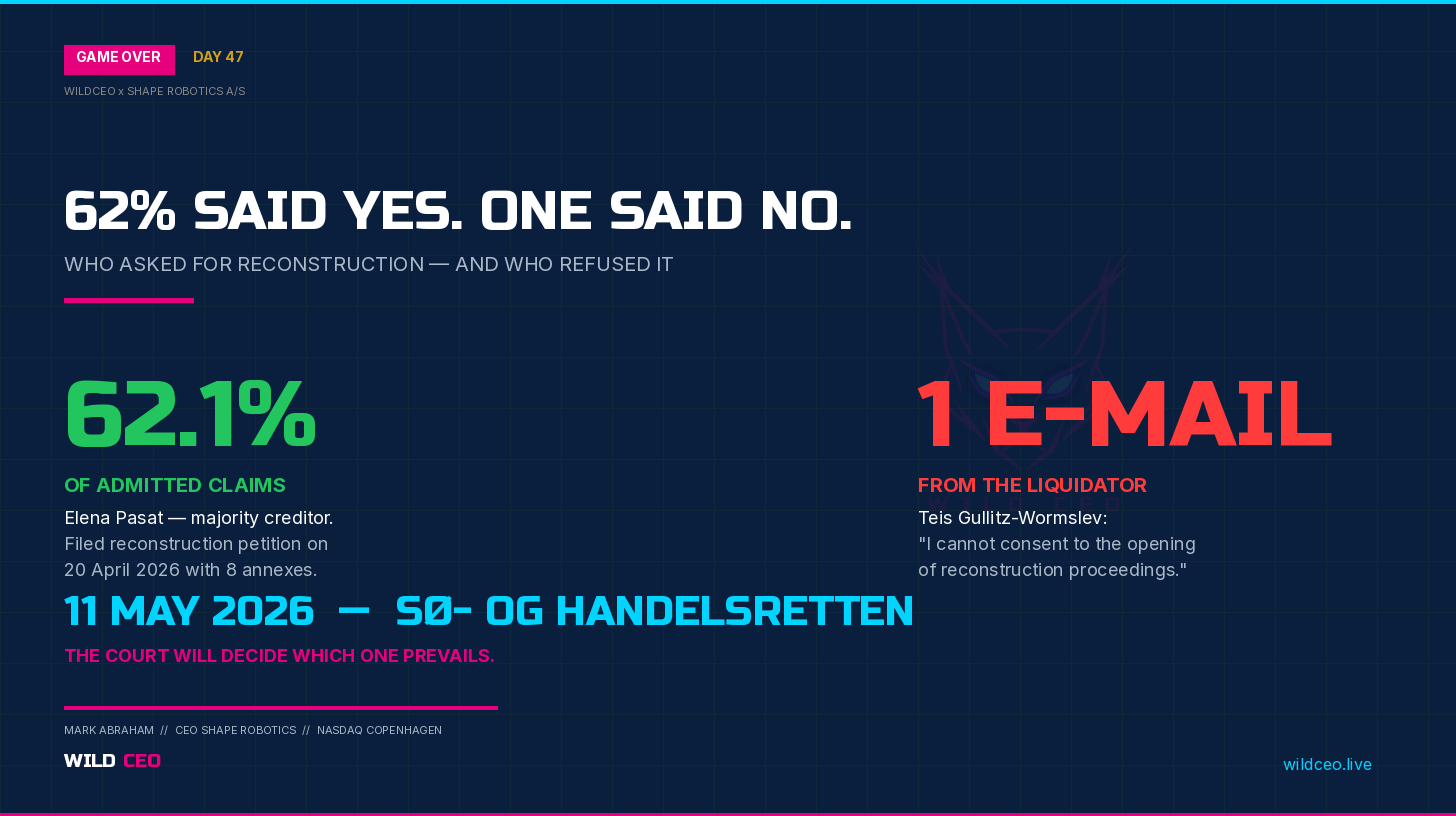
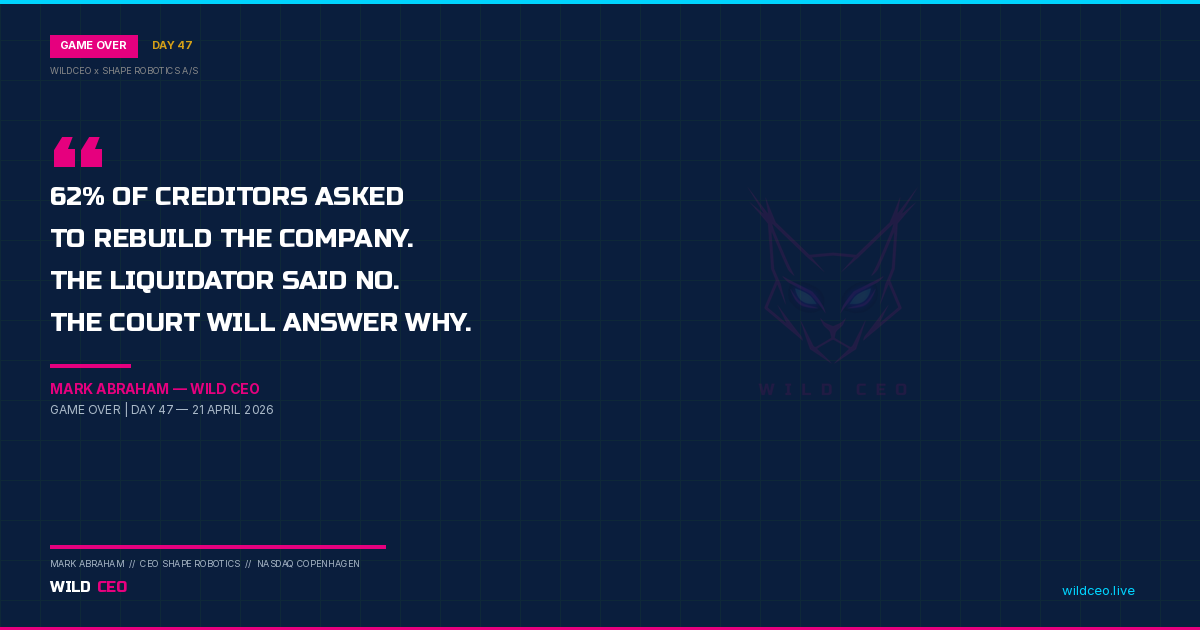
Petitioner:              Elena Pasat (majority creditor, 62.1% of admitted claims)
Represented by:          Attorney Philip A. Borreschmidt
Petition filed:          20 April 2026
Petition content:        Begæring om rekonstruktionsbehandling
                         (petition for reconstruction proceedings)

Liquidator's response:   E-mail of 20 April 2026 from Teis Gullitz-Wormslev
                         — "I cannot consent to the opening of reconstruction"

Court's decision today:  Hearing scheduled for
                         Monday, 11 May 2026, at 09:30
The court also made a procedural note that did not exist on 17 April, and I will return to it at the end of this article.
📜 Two procedures, one company, opposite directions
Before anyone can understand what happened today, two Danish legal concepts must be kept clearly apart:
Callout — Reconstruction vs. Liquidation
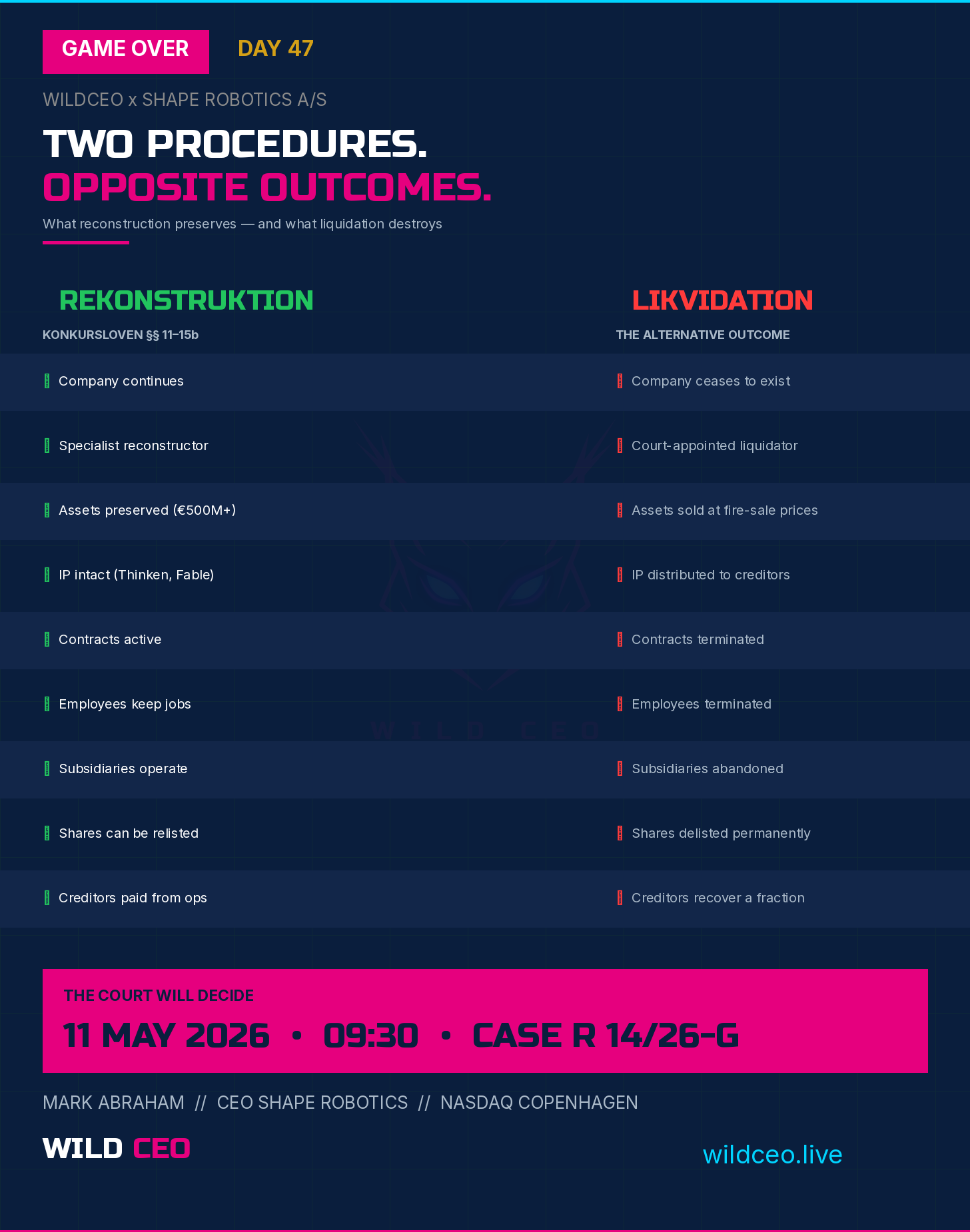
🟢 Rekonstruktion (reconstruction, konkursloven §§ 11–15b) — the company continues to operate. A specialist reconstructor takes control, negotiates with creditors, preserves the assets, restructures the debt, and restores the business to a viable state. Shares can be relisted. Employees keep their jobs. Contracts continue. Creditors are paid from ongoing operations over time.
🔴 Likvidation / konkurs (liquidation / bankruptcy) — the company ceases to exist. The liquidator sells the assets, terminates the contracts, dismisses the employees, and distributes what is left among the creditors in statutory order. Value is destroyed; creditors recover a fraction of what the company’s ongoing operations would have paid.
These are not aesthetic variations of each other. They are opposite outcomes. One preserves value. The other destroys it.
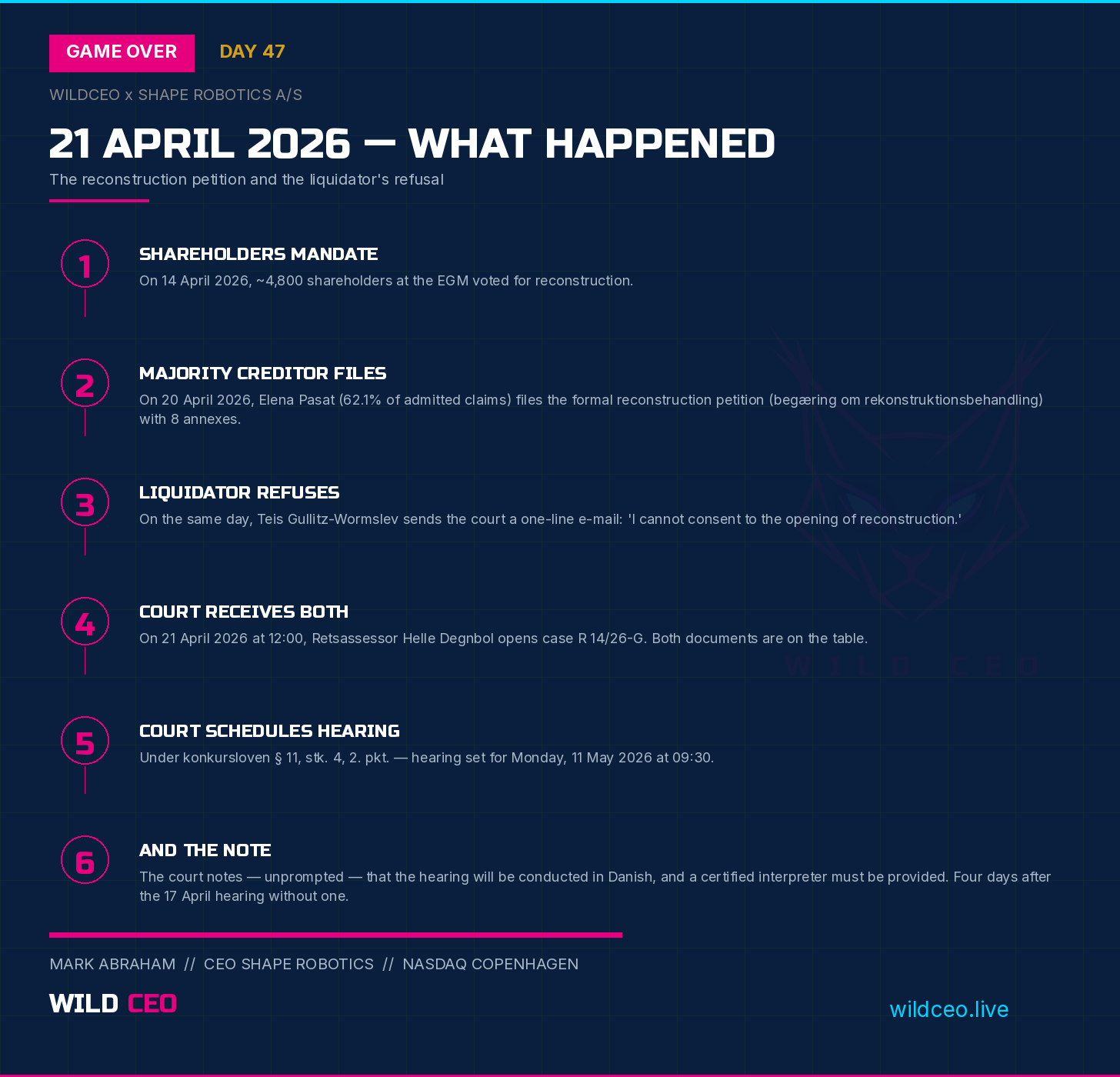
On 14 April 2026, the shareholders of Shape Robotics A/S — at a properly held EGM, under Danish law, with legal representation — voted in favor of reconstruction. That is a mandate with legal weight.
On 20 April 2026, the dominant creditor — holding 62.1% of all admitted claims — filed the formal petition to convert the mandate into a court procedure. The petition cited the relevant sections of the konkurslov (§§ 238, 238(4), and 238a), proposed a named reconstructor, and attached the eight annexes the law requires.
And on the same 20 April 2026, one e-mail arrived at the court from one person. The court-appointed liquidator. “I cannot consent.”
📄 The court record, in one page
The court record of today is attached to this post in both the Danish original and an English translation.
Here is what it says, in essentials:
The court:
Acknowledged the reconstruction petition from Elena Pasat with all eight annexes.
Acknowledged the e-mail refusal from the liquidator.
Scheduled a hearing for Monday 11 May 2026 at 09:30 — under konkursloven § 11, stk. 4, 2. pkt.
Ordered Elena Pasat to have the annexes translated into Danish (we had already begun this yesterday).
Directed that a transcript of the court record be sent to the parties — including, for the first time in this matter, “Mark-Robert Abraham via Bo K. Larsen” — and to the creditors in the six pending bankruptcy cases.
And then the court added a note that nobody asked for, but that changes everything on one level: the hearing will be conducted in Danish, and if an interpreter is required, the parties must bring a certified interpreter.
I will come back to that sentence at the end of this article. It is the most important eight words of the day.
🔍 The arithmetic of the refusal
This is where I try to stay on the ground, because I respect the court and I will not speculate on what is in anyone’s mind. But there is simple arithmetic that anyone can read.
Callout — The numbers on the table
• 62.1% of admitted claims — the proportion held by Elena Pasat, who asked for reconstruction. • 100% of shareholder votes at the 14 April EGM — the proportion who mandated reconstruction. • 4,800 — the approximate number of those shareholders. • DKK 50,000 — the statutory fee a court-appointed liquidator receives. Not the reconstruction fees, not the billable hours, not the future mandates. Fifty thousand crowns total, under the court’s appointment. • DKK 3,722,813 — the sum held in Kromann Reumert’s own client account, described by Shape Robotics A/S in Company Announcement No. 10-26 (7 April 2026) as “uautoriseret” — “unauthorised”.
The court-appointed liquidator is, in law, the caretaker of the company’s assets. Not an adversary of the majority creditor. Not an obstacle to the shareholders’ mandate. A caretaker.
A caretaker may have legitimate reasons to hesitate when asked to step aside for a specialist reconstructor. Those reasons, whatever they are, will be heard on 11 May. I will not anticipate them. I will not guess at them. The court will hear them and decide.
What I can say, as CEO, is that the procedure the majority creditor asked for is the procedure that, under Danish law, exists precisely to prevent the outcome of liquidation when a going-concern value is available. That is what rekonstruktion is for. The konkurslov was amended in 2022 specifically to make reconstruction more accessible, after Directive 2019/1023 required EU member states to provide preventive frameworks against the unnecessary destruction of viable businesses.
Shape Robotics A/S is such a business. The same €500M+ in assets enumerated in yesterday’s appeal exists today. The Bechtle German contract — approximately €40 million, regardless of what the 17 April court record says — is still alive. The Romanian subsidiary is still operating. The Lenovo partnership is still in place. The PNRR project is still won at the Bucharest Court of Appeal.
The question the court will answer on 11 May is whether a going-concern reconstruction is feasible under Danish law in these circumstances.
The question for the reader is different. It is rhetorical, and it belongs to you, not to me.
⚖️ Why the refusal is — structurally — surprising
I will state four facts, each documented in a public filing, and I will let you connect them as you see fit.
Fact 1. The 62.1% majority creditor asked for reconstruction. In any rational creditor ranking, the preference of the largest single creditor carries disproportionate weight.
Fact 2. The shareholders unanimously mandated reconstruction at a lawful EGM on 14 April 2026.
Fact 3. The company holds more than €500M in documented assets (intellectual property, contracts, damages claim vs. Carnegie, secured financing, operating subsidiaries). Reconstruction preserves these assets. Liquidation does not.
Fact 4. The court-appointed liquidator’s prior trustee mandate over the same company was unanimously annulled by Østre Landsret on 5 March 2026. His firm holds DKK 3.72M of the company’s money in its own name, described by the company as “unauthorised”. He is the subject of a pending criminal complaint filed on 26 March 2026 with the Bucharest Prosecutor’s Office, and of a complaint to the Copenhagen Police (ref. 0100-83986-10362-26).
Given those four facts, a consent to reconstruction would have been — from a purely procedural standpoint — the path of least resistance. The majority creditor would get what she asked for. The shareholders would get what they mandated. The assets would be preserved. The liquidator’s statutory fee would remain the same. The reconstructor, an independent specialist from a different firm (Mazanti-Andersen, recommended by us for this case), would take over the complex operational work.
On balance, there is no obvious procedural reason to refuse.
🎯 What I am not saying
I am not saying the refusal is unlawful. It is not. A liquidator has the right to withhold consent under Danish law, and the court will hear his reasons on 11 May.
I am not imputing motives. I cannot read minds, and I will not pretend to.
What I am saying is that, given the four documented facts above, the refusal is structurally surprising. It is the kind of choice that invites a rhetorical question. The question does not belong to me. It belongs to anyone who reads those four facts in sequence.
The question is: why?
📌 The one note in today’s court record that changes everything
I promised I would return to it.
Compare two court records, forty-eight hours apart, from the same judge, about the same company.
Retsbog of 17 April 2026 (the tvangsopløsning hearing): I was examined under strafansvar — criminal sanction — in English, without a certified Romanian interpreter. No consular notification. No mention, anywhere in the record, of the language or interpreter question.
Retsbog of 21 April 2026 (the rekonstruktion scheduling): “Det bemærkes, at retsmødet vil foregå på dansk. Er der behov for tolk, må parterne selv medbringe en autoriseret tolk.”
(Translation: “The court notes that the hearing will be conducted in Danish. If an interpreter is required, the parties must themselves bring a certified interpreter.”)
Forty-eight hours and one appeal later, the same court — in an act of its own initiative, on a point nobody raised in today’s filings — issued an explicit procedural instruction about interpretation.
I will not describe what that means. I will let you draw your own conclusions. But I will say this: for a Romanian citizen who, four days ago, gave sworn testimony in a language not his own, translated by the opposing party’s counsel, and for whom that very issue was filed as Ground 3.1 of an appeal at 09:00 on 20 April, the quiet appearance of this note in a procedural order on 21 April is not nothing.
It is not an admission. It is not a concession. It is, perhaps, simply — the system catching up to itself.
🗓️ What happens between now and 11 May
Date Event 21 Apr 2026 ✅ Court scheduled reconstruction hearing. By 27 Apr 2026 (approx.) Elena Pasat submits Danish translations of annexes 2, 3 (central parts), 4, 6–7 (central parts), and 8. Between now and 11 May Liquidator may file a substantive position on the reconstruction petition. Between now and 11 May Østre Landsret may rule on the opsættende virkning (suspensive effect) request from yesterday’s appeal. Mon 11 May 2026, 09:30 Hearing on the reconstruction petition. “Retsmødet vil foregå på dansk. Er der behov for tolk, må parterne selv medbringe en autoriseret tolk.” We will bring one. Wed 20 May 2026, 09:30 Six pending bankruptcy petitions (K 2932/25-E, K 2992/25-E, K 3337/25-B, K 18/26-D, K 653/26-K, K 652/26-E).
The convergence of these dates is not coincidence. It is procedure. Three tracks — the appeal, the reconstruction, and the bankruptcy petitions — will intersect within the next 30 days. Whichever one concludes first shapes the others.
🏗️ Why reconstruction matters beyond this case
Callout — For readers interested in EU insolvency law
Directive 2019/1023 on preventive restructuring frameworks was adopted by the European Parliament in June 2019 and transposed into Danish law by Lov nr. 896 af 21/06/2022. The Directive’s purpose is to give viable businesses in financial distress a second chance before liquidation, so that jobs, know-how, and economic value are preserved rather than destroyed.
The Directive applies across all EU member states. The principles it codifies — majority-creditor preference, debtor-in-possession arrangements, specialist reconstructor oversight — are now part of the shared procedural fabric of European corporate law.
A Danish court considering reconstruction in 2026 is not applying a domestic oddity. It is applying a pan-European framework designed to prevent exactly the outcome that liquidation without reconstruction produces: the loss of viable businesses in the middle of procedural battles.
This is why the majority creditor filed. This is why the shareholders mandated it. This is why, on 11 May, Sø- og Handelsretten will consider — under a framework the EU itself designed — whether Shape Robotics A/S should be rebuilt rather than taken apart.
I respectfully submit that the court will hear the arguments, apply the law, and reach its own conclusion. My job, and the job of this publication, is simply to keep the record public while it does so.
🔭 For Teis Gullitz-Wormslev and Kromann Reumert
If any sentence in this article is factually inaccurate, please write to me at mark@shaperobotics.com. I will publish a correction in the next edition with the same prominence as the original claim.
I have taken care to stay strictly within the four corners of the filed documents — the court record of 21 April 2026, the e-mail refusal acknowledged in it, the Company Announcement No. 10-26 of 7 April 2026, the 5 March 2026 ruling of Østre Landsret, and the criminal complaints on public record. Nothing here is speculation. Everything here can be verified from the attachments below.
The Denmark I still believe in
Yesterday I wrote about the five-judge panel of Østre Landsret that, on 5 March 2026, did its job with rigor and unanimity. Today I write about a different judge — Retsassessor Helle Degnbol — who, in the space of four days, first presided over a hearing where a Romanian was examined under criminal sanction without a certified interpreter, and then, on her own initiative, in a subsequent procedural order, wrote that interpretation must be provided at the next hearing.
That is not the end of the matter. The 17 April retsbog still exists. The examination happened. The appeal is filed. But the evolution between 17 April and 21 April is, to use Andersen’s words, “et lille glimt af det, der kommer” — a small glimpse of what is coming.
The Denmark of Kierkegaard self-corrects. The Denmark of Andersen notices. The Denmark of the maritime merchants adapts. I still believe in that Denmark, and I am watching this week’s record carefully because it suggests that Denmark may, quietly, be doing its work.
On 11 May, we will know more.
Mark Abraham Founder & CEO, Shape Robotics A/S Administrator, Shape Robotics România S.R.L. Romanian citizen · Copenhagen · Bucharest mark@shaperobotics.com · +40 749 288 688
“A system that survives on silence dies the moment someone refuses to be canceled — but the refusal is worth more when it is filed through proper channels, documented in the official record, and offered in good faith to the court that decides.”
Yesterday’s complete appeal to Østre Landsret, with all eight exhibits. The procedural questions raised in this appeal remain pending before the High Court in parallel with the reconstruction proceedings.
🔔 Subscribe
Thanks for reading Wild CEO — The Journey! This post is public so feel free to share it.
I will publish — as filings and rulings come in — only what is in the official record. No commentary on merits pending decision. No speculation about intent. Just the documents and the procedural posture:
The liquidator’s substantive position on the reconstruction petition (if filed).
Østre Landsret’s ruling on suspensive effect (pending from yesterday).
The 11 May ruling on reconstruction.
The 20 May hearing on the six pending bankruptcy petitions.
Any public response from Kromann Reumert or any party to these proceedings.
Progress of the Romanian criminal investigation.
Documentation over speculation. Procedure over noise.
This is Wild CEO.
Get more from Mark Abraham in the Substack app
Available for iOS and Android
Discussion about this video
GAME OVER
Daily war room dispatches from the reconstruction. The GAME OVER series documents every move in real time.
Daily war room dispatches from the reconstruction. The GAME OVER series documents every move in real time.